“Every blood donor is a hero”, donating blood helps other people to maintain good health or allow them to stay alive. Indeed, donating blood does bring kinds of advantages but not only saving people’s lives. Blood donor can gain emotional and mental health as well as physical health because we know that helping others can have a positive effect on the people performing the good deed and people also get a free health checkup when they donate blood. However, how well do you know about the code of ethics for blood donation and transfusion ?
Chapter 3 — Selection and Retention of Donors and Code of Ethics for
Blood Donation and Transfusion
(Private Healthcare Facilities and Services Regulations 2006)
299. Blood donor recruitment, selection and care
(1)
A private healthcare facility or service providing blood transfusion services and blood donation programmes shall ensure the safety of donors and recipients and shall draw up criteria and standards for blood donor recruitment, selection and care.
(2)
Such criteria and standards shall be consistent with the Code of Ethics for Blood Donation and Transfusion, Ministry of Health as stated in the Eleventh Schedule.
(3)
Blood donation programmes shall develop mechanisms for selecting safe donors and screening out donors with risk factors for transmissible diseases through transfusion and mechanisms to encourage donors with the risk factors for the transmissible diseases through transfusion diseases not to donate by self-exclusion or self-referral.
(4)
The licensee or person in charge or head of blood bank services of a private healthcare facility or service shall ensure that the effectiveness of mechanisms referred to in subregulation (3) are monitored and evaluated regularly.
(5)
Blood donation programmes shall have adequate record systems and an effective recall system for regular and safe donors.
Eleventh Schedule
CODE OF ETHICS FOR BLOOD DONATION AND TRANSFUSION
I. The donor
- 1. Blood donation shall, in all circumstances, be voluntary; no pressure of any kind shall be brought upon the donor.
- 2. The donor shall be advised of the risks connected with the procedure; the health and safety of the donor shall be a constant concern.
- 3. Financial profit shall never be a motive either for the donor or for those responsible for collecting the donation. Voluntary non-remunerated donor should always be encouraged.
- 4. Anonymity between donor and recipient shall be respected except in special cases.
- 5. Blood donation shall not entail discrimination of any kind, either of race, nationality or religion.
- 6. Blood shall be collected under the responsibility of a registered medical practitioner.
- 7. The frequency of donations and the total volume of blood collected according to the sex and weight of the individual, as well as the minimum and maximum age limits for blood donation, shall be as specified by the Director General.
- 8. Suitable testing of each donor and blood donation shall be performed in an attempt to detect any abnormalities-
- (a) that would make the donation dangerous for the donor; and
- (b) that would likely be harmful to the recipient.
- 9. Donation by plasmapherisis should be the subject of special regulations that would specify-
- (a) the nature of additional tests to be carried out on the donor;
- (b) the maximum volume of plasma to be taken during one session;
- (c) the maximum time interval between two consecutive sessions; and
- (d) the maximum volume of plasma to be taken in one year.
- 10. Donations of leucocytes or platelets by cytapherisis should be the subject of special regulations that would specify-
- (a) the information to be given to the donor about any drugs injected and about the risks connected with the procedure;
- (b) the nature of any additional tests to be carried out on the donor; and
- (c) the number of sessions within a given time frame.
- 11. Deliberate immunization of donors by any foreign antigen with the aim of obtaining products with specific diagnostic or therapeutic activity should be the subject of special regulations that would specify-
- (a) the information to be given to the donor about the substance injected and the risks involved; and
- (b) the nature of any additional tests which have to be carried out on the donor.
- 12. Pursuant to paragraphs 9, 10 and 11 of this Code, after being told about the nature of the operation and the risks involved, a statement of consent must be signed by the donor.
- 13. For donor immunized against red cell antigens, a special card should indicate the antibodies and specific details as to the appropriate blood to be used in case donors need to be transfused.
II. The recipient
- 1. The object of transfusion is to ensure for the recipient the most efficient therapy compatible with maximum safety.
- 2. Before any transfusion of blood or blood products, a written request signed by a registered medical practitioner or issued under his responsibility shall be made, which specifies the identity of the recipient and the nature and quantity of the substances to be administered.
- 3. Except for the emergency use of type “O” blood or red blood cells, every red blood cell transfusion necessitates preliminary blood grouping tests on the recipient and compatibility tests between the donor and the recipient.
- 4. Before the administration, one shall verify the blood and blood products are correctly identified and that the expiry date has not been passed. The identity of the recipient shall be verified.
- 5. The actual transfusion shall be given under the responsibility of a registered medical practitioner.
- 6. In the case of a reaction during or after the injection of blood or blood products, appropriate investigations may be required to ascertain the origin of the reaction and to prevent its recurrence. A reaction may require the interruption of the transfusion.
- 7. Blood and blood products shall not be given unless there is genuine therapeutic need. There shall be no financial motivation on the part of either the prescriber or the establishment where the patient is treated.
- 8. Whatever their financial resources, all patients must be able to benefit from the administration of blood or blood products, subject only to their availability.
- 9. As far as possible the patient should receive only the particular component (cells, plasma or plasma derivatives) that is needed. To transfuse whole blood into a patient who requires only part of it may deprive other patients of necessary components, and may carry some additional risks to the recipient.
- 10. Owing to the human origin of blood and to the limited quantities available, it is important to safeguard the interest of both recipient and donor by avoiding abuse or waste.
- 11. The optimal use of blood and blood products requires regular contact between the physician who prescribe and those who work in blood transfusion centres.
III. Control
- 1.Appropriate controls shall be required to verify that blood transfusion practices meet internationally accepted standards and that guidelines or regulations issued in accordance with this Code are followed.
- 2.The following should be regularly checked-
- (a) the proficiency of the staff;
- (b) the adequacy of equipment and premises; and
- (c) the quality of methods and reagents, source materials and finished products used.
Additional Information: BLOOD DONOR ELIGIBILITY CRITERIA
- Well and healthy
- Age:
- First time donor: 18-60 years old
- Regular donor: 18-65 years old
- Prospective donor aged 17 years old must provide written consent from his or her parents / guardian
- Weight : 45kg and above
- Had minimum of 5 hours sleep
- Had a meal before blood donation
- No medical illness
- Not involved in any high risk activities such as :-
- Same gender sex (homosexual)
- Bisexual
- Had sex with commercial sex worker
- Change in sexual partner
- Took intravenous drug
- A sexual partner of any of the above
- Last whole blood donation was 3 months ago
- For female donors : not pregnant, last menstrual period was more than 3 days ago, and not breastfeeding
- Do not donate blood if you had:
- Stayed in United Kindom (England, Northern, Ireland, Scotlaand, Wales, Isle of Man atau Channel Island) atau Republik Ireland from year 1980 until 1996 for period of 6 months or more.
- Stayed in Europe from year 1980 until now, for a period of 5 years or more.
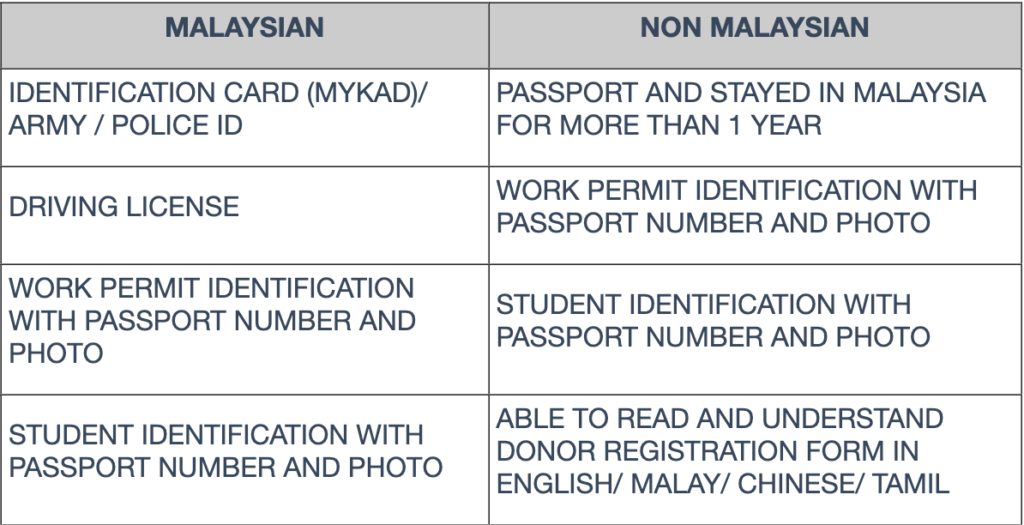
- Bring along the ORIGINAL document below :-