

Cryptocurrency is a digital currency that uses an online ledger with strong cryptography to secure online transactions. It is a form of intangible transaction that uses ‘tokens’ as a trading medium in exchange for goods or services.
Over the years, cryptocurrency has been making big waves in Malaysia; Bitcoin, Dogecoin, Ethereum & Tether, to name a few. It is estimated that over 3.1% of Malaysia’s total population (± 1.0 Million people) currently own cryptocurrency. With this new form of currency coming in play in the exchange of goods and services, it is important to know whether the profits earned from cryptocurrency can be taxed in Malaysia.
The answer is: YES.
According to the Inland Revenue Board (IRB)/ Lembaga Hasil Dalam Negeri (LHDN), active cryptocurrency investors who trade their assets at the digital asset exchange are subjected to declare their gains for purposes of their annual income tax.
This taxation of cryptocurrency is based on Section 3 of the Income Tax Act 1967 which states that “a tax to be known as income tax shall be charged for each year of assessment upon the income of any person accruing in or derived from Malaysia or received in Malaysia from outside Malaysia”,
and
Section 4 which states that “subject to this Act, the income upon which tax is chargeable under this Act is income in respect of – (f) gains or profits not falling under any of the foregoing paragraphs” (which includes gains or profits made from trading cryptocurrency).
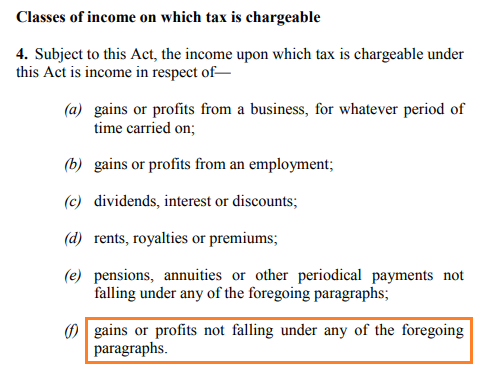
Based on the Act, LHDN mentioned that similar tax treatment will be applied to income earned from conventional businesses to income earned from digital platforms (crypto). This would mean that the gains/profits made by individuals who trade cryptocurrency actively would be taxable.
LHDN also mentions that the Act does not specify on how the gains from the cryptocurrency can be taxed. Thus, tax regulators would be required to handle each scenario on a case-to-case basis to determine whether the gains made by an individual are taxable or not.
However, LHDN has provided an explanation on how cryptocurrency will be taxed: the pattern of trade.
LHDN mentions that if passive cryptocurrency traders whose capital gains are occasional and unsystematic, then the profit would be a tax-free income, while active traders whose capital gains are systematic and frequent, where the patterns of badges of trade exist, the profits will be subjected to an income tax.


