REAL PROPERTY GAINS TAX IN MALAYSIA (RPGT)
Real Property Gains Tax (RPGT) is a form of Capital Gains Tax that is imposed on the disposal of property in Malaysia. It was suspended temporarily in 2008-2009, and reintroduced in 2010. In 2014, RPGT was increased for the 5th straight year since 2009. So how is it calculated, and what does it impact?
Based on the Real Property Gain Tax Act 1976, RPGT is a tax on chargeable gains derived from disposal of property and is payable to the Inland Revenue Board. A chargeable gain is the profit when the disposal price is more than purchase price of the property. For instance, if Mr. X purchased a piece of property in 2000 at a value of RM500,000. Subsequently, X sold the property to Mr. Y at the value of RM700,000, gaining RM200,000 from the disposal of the property. The RPGT is calculated for RM200,000.
What most people do not know is that RPGT is also applicable in the procurement and disposal of shares in companies where 75% of their tangible assets are in properties – i.e. Real Property Companies (RPC). RPGT applies to both residents and non-residents.
One will be only be taxed on the positive net capital gains which is disposal price less the purchased price less the miscellaneous charges such as (stamp duty, legal fees, advertisement charges, etc). Additionally, a waiver on the taxable amount is granted to individuals (but not companies).
WHEN DO I HAVE TO PAY RPGT?
The purchaser’s solicitors are required to retain 3% of the purchase price from the deposit and remit the same to the Inland Revenue Board within sixty (60) days from the date of the sale and purchase agreement to meet the RPGT payable.
In situations where the consent of the State Authority is required to sell the property to a purchaser and/or charge the property to a financial institution, or a court order for sale is required to dispose of the property, remittance of the 3% of the purchase price may be deferred until such consent or court order for sale is obtained.
The holding period is from the date on the S&P agreement till to the disposal date. For a simple and a quick calculation, the formula is:
Chargeable Gain = Disposal Price – Purchased Price
Net Chargeable Gain = Chargeable gain – Exemption Waiver (RM10,000 or 10% of Chargeable Gain, whichever is higher)
WHAT ARE THE EXEMPTIONS?
There are also exemptions allowed for RPGT. This exemption is only applicable for the disposal of a “private residence” and not applicable to commercial property. The Real Property Gains Tax Act defines a private residence as a building or part of a building in Malaysia owned by an individual and occupied or certified fit for occupation as a place of residence. Among the exemptions are:
1) Exemption on gains from the disposal of one residential property once in a lifetime to individual, and not applicable if the private residence is owned by a company.
2) Exemption on gains arising from the disposal of real property between family members (e.g. husband and wife, parents and children and grandparents and grandchildren).
3) 10% of profits OR RM10,000 per transaction (whichever is higher) is not taxable.
In order to apply for an exemption, the applicant must show that:
(i) the private residence is owned and occupied by an individual; and
(ii) the certificate of fitness for occupation or the Certificate of Completion & Compliance has been issued for that private residence.
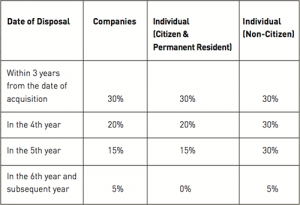
RPGT RATES
The following is the RPGT rates effective from 1st January 2014.
CONCLUSION
The hike in RPGT has its own pros and cons. It has less impact on genuine buyers compared to speculators as the process of getting a loan for property is a complex and a tedious one.