Faraid is a concept in Islamic Law, which determines the distribution of a deceased’s property to heirs in portions as set out in Al-Quran, As-Sunnah and Al-’Ijma.
Before proceeding any further, a few terminologies should first be understood.
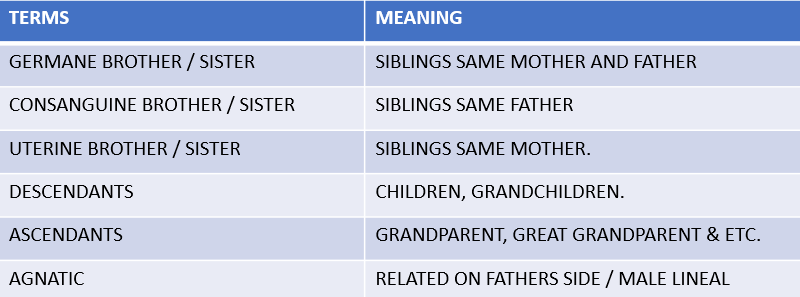
With these terms in mind, there are two types of heir who can inherit under faraid, namely Quranic heirs (Ashab Al Furudh) and residuary heirs (Asabat).
Quaranic Heirs/Primary Heirs
Quranic heirs consist of three different types of heirs:
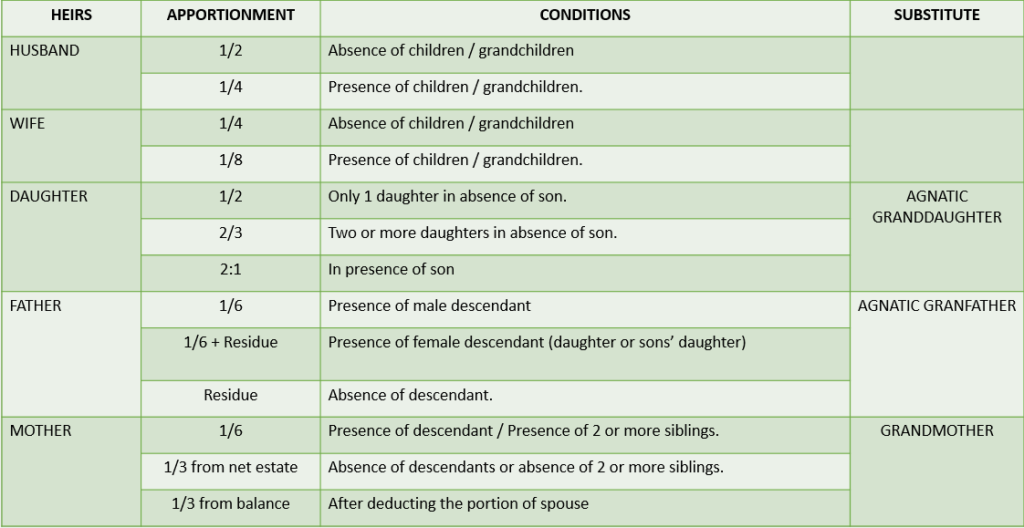
1) Primary heirs: father, mother, spouse and daughter
2) Secondary heirs: germane sister, consanguine sister, uterine sister and uterine brother
3) Substitute heirs: grandfather, grandmother and granddaughter
The apportionment for primary heirs are as follows:
Residuary Heirs/ Secondary Heirs
On the other hand, secondary heirs consist of asabat sababiyah who are residuary heirs by cause (i.e. the master of freed slaves) and asabat nasabiyah who are residuary heirs by blood.
Asabat nasabiyah are further categorised as the following:
1) Asabat nasabiyah binafsi (residuary heir in his own right): son, agnatic grandson, father, paternal grandfather, germane brother, consanguine brother, son of germane brother, son of consanguine brother, germane brother of father, consanguine brother of father
2) Asabat nasabiyah bilghayr (residuary heir through another): daughter [counterpart – son], son’s daughter [counterpart – son’s son], germane sister [counterpart – germane brother] and consanguine sister [counterpart – consanguine brother]
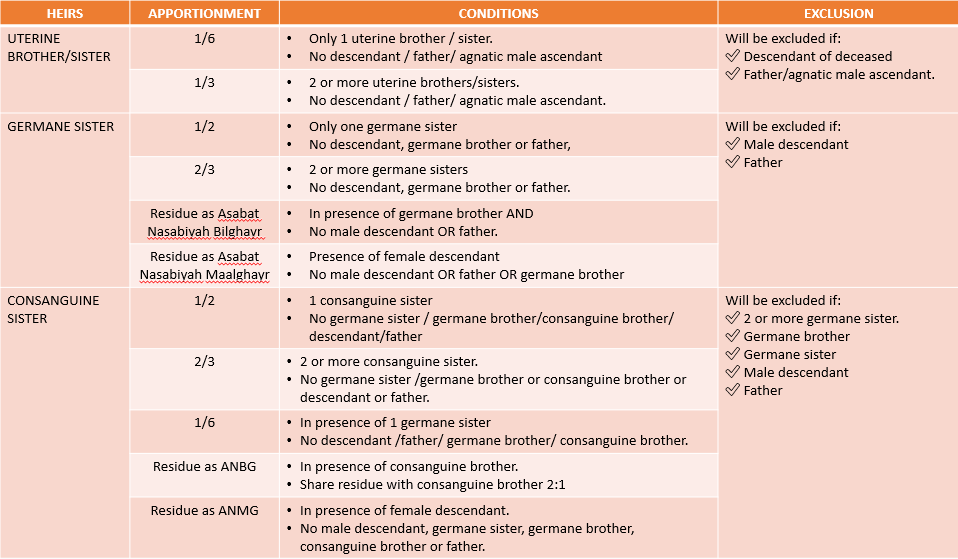
It should be noted that in the presence of their male counterpart, they will not take their fixed. Should their male counterpart(s) of the same class and degree exists, they will share the residue with the ratio of 2:1 (male:2, female:1). They are only entitled to inherit the residue if their male counterpart exists. Besides, the Asabat Nasabiyah Bilghayr are also listed according to hierarchy. If a person with a degree or class above them exists, they will not be entitled to inherit the residual estate.
3) Asabat Nasabiyah Maalghayr (residuary heir in the company of another): germane sister and consanguine sister
It should be noted that they may only inherit the residue and not the whole of the estate. They will inherit the residue of the estate in the absence of their male counterparts or father or any male descendants and only in the presence of female descendant(s).
The apportionment for secondary heirs are as follows: