Who is an intestate?
A person who dies without leaving a valid will is said to have died intestate.
Types of intestacy
Intestacy can either be total or partial.
1) Total Intestacy
Total intestacy occurs when a person dies without leaving a valid will disposing their property. As such, all their assets will be distributed according to the Distribution Act (“DA”).
Total intestacy can occur due to several reasons:
a) The deceased never made a will
b) The will made was invalid due to defective execution or the deceased’s lack of capacity
c) The deceased previously made a will but revoked it
d) The deceased made a will but it failed to wholly dispose their property (e.g. sole beneficiary predeceased the testator)
e) The deceased made a will which contained no disposition of his property
2) Partial Intestacy
Partial intestacy occurs where a testator makes a will but fails to dispose some of their property. This failure may be deliberate or a mistake (e.g. caused by forgetfulness). It should be noted that such a will is valid but the assets left out from the will are to be disposed of under the DA. Partial intestacy may also occur if some of the beneficiaries predecease the deceased or if the will was partially revoked.
Therefore, it is highly encouraged for wills to have residuary clause so that unmentioned properties can be disposed to a particular beneficiary. An example of a clause is “all my remaining properties go to ABC”.
Right of Inheritance under Intestacy
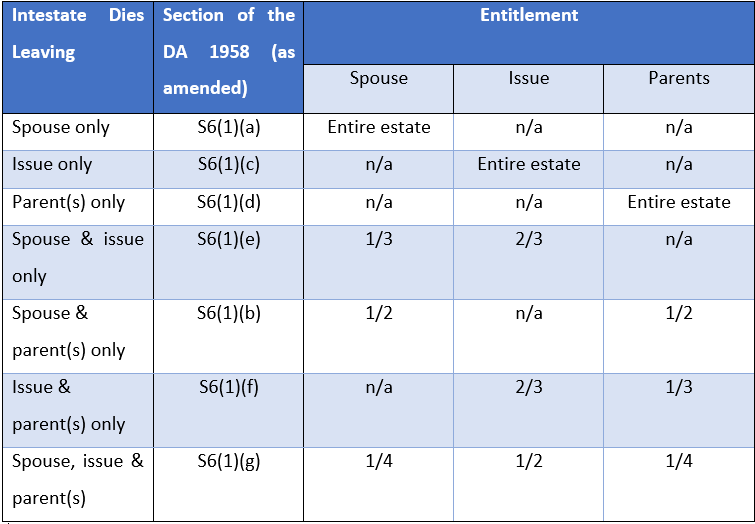
The entitlement of an intestate’s spouse, issue (including legitimate children and the descendants of deceased children) and parent(s) are as follows:
It should be noted that if the spouse is divorced, their position must be known. If the position of divorce is within the application stage, they are considered to be still married. As such, they may inherit each other should one of them passes away.
Besides, before a decree absolute is given, they are still considered married. As such, once the decree absolute is granted, they are officially divorced and thus cannot inherit each other. This is as per the case of In the Estate of Isabella Wallace whereby it was held that if a decree nisi has been obtained but decree of absolute has not been granted, the two are still married and can inherit each other.
However, if the is a void marriage, there is no marriage. As such, they cannot inherit each other.