
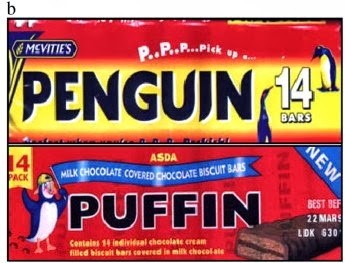
Can you spot any similarities in the two chocolate bars above? Would you think the two products are somehow related or they come from the same source? The picture above actually represents a real case called United Biscuits (UK) Ltd v Asda Stores Ltd [1997], where United Biscuits won a ‘passing off’ action against Asda over the similarity of its Penguin biscuits to the Asda’s Puffin bars. However, United Biscuit lost its trade mark infringement claim that the name Puffin had infringed Penguin’s registered trade mark. You may wonder… why is that the case?
Why the passing off action succeed while the trade mark infringement action failed?
When United Biscuit registered for trade mark, it only registered the word ‘Penguin’ as a trade mark. So, when Asda sold its chocolate bars under the name ‘Puffin’, there was no trade mark infringement because the word ‘Penguin’ and ‘Puffin’ are not sufficiently similar, taken phonetically and visually. The court will disregard the context (ie: packaging colour, other unregistered images and slogan) when assessing a trade mark claim. On this basis, United Biscuit failed in trade mark infringement action.
On the other hand, when assessing a passing off claim, the court will look at the entire product as a whole (taking into account all its distinctive features, get up, mark, slogan, name etc.) One never need to register the mark/name, passing off arises automatically when one party uses the goodwill of another party for their own benefit. In the case above, the court found that Asda’s use of the red packaging, the name ‘Puffin’ and the content were deceptively similar to that of Penguin, confusing consumers into believing that they are from the same or related sources. In other words, the fact that Asda chose the name ‘Puffin’, the red colour wrapping and the penguin image suggested that Asda was trying to mimic United Biscuit’s Penguin biscuits and borrow its well-established goodwill to promote their chocolate bars. All these, when taken as whole, constitute passing off.
| Elements of Passing Off | Elements of Trade Mark Infringement |
| 1. Must prove goodwill in the product | 1. No need to prove goodwill |
| 2. Misrepresentation leading to actual confusion among average consumers. Innocent misrepresentation is no defence. | 2. The conflicting mark must be ‘confusingly similar’ to the registered mark (visually, phonetically, conceptually). |
| 3. Must show damage or likelihood of damage | 3. No need to prove damage, as long as element 2 is satisfied and the mark is a registered trade mark. |
| * Do not need to register to claim protection | * Must be registered to claim protection |


