
Introduction
According to the International Olympic Committee, doping is defined as the use of substances or techniques in any form or quantity alien or unnatural to the body with the exclusive aim of obtaining an artificial or unfair increase in performance in competition. It involves using stimulating agents that push the athlete beyond his normal limits of performance in order to gain an advantage over others in sporting competitions.
Doping is prohibited by all sports organisations at all levels to prevent sportspersons from acquiring unfair advantages through the use of banned substances or methods to enhance performance. A sportsperson’s success or failure should be determined by his talent, speed, skill, and consistent training. Drug abuse violates these notions of equality in competition.
Lance Armstrong Confessed to Doping in Tour de France Titles
In a television interview with Oprah Winfrey broadcast, cyclist Lance Armstrong admitted that he doped to win all seven of his Tour de France titles. He confessed to using the performance-enhancing drug EPO, testosterone, and blood transfusions to win his seven Tour de France races, claiming that he could not have won without them. As a result, Armstrong received a lifetime ban and was stripped of all his victories since August 1998, including his seven Tour de France titles from 1999 to 2005.
Doping Violations in Malaysian Athletics
Badminton player Lee Chong Wei was banned by the Badminton World Federation for eight months for a doping violation after the banned substance dexamethasone was found in his system while competing in the World Championship in Copenhagen in August 2014.
National high jumper Ngu Jia Xin was confirmed to have failed a doping test in 2023 and received a two-year ban from participating in any competitions from 2 June 2023 to 1 June 2025.
The first case involving Malaysian sports officials in a doping investigation occurred in 2012 and involved the former deputy president of the Malaysian Athletic Federation, Datuk Karim Ibrahim. Karim was investigated for allegedly supplying banned drugs to the relay runner Mohammad Yunus Lasaleh, who claimed that he was given pills disguised as vitamins and injections from a Bulgarian doctor before the Southeast Asian Games. Subsequently, the relay team was stripped of their gold medals after Yunus failed doping tests, and Karim was banned for six years.
WADA & WADC
The World Anti-Doping Agency (WADA) was established in 1999 as an international independent agency to lead a collaborative worldwide movement for doping-free sport. Its primary role is to develop, harmonise and coordinate anti-doping rules and policies across all sports and countries.
The World Anti-Doping Code (WADC) is the core document that harmonises anti-doping policies, rules, and regulations within sport organisations and among public authorities around the world.
The WADC Prohibited List is a mandatory International Standard as part of the World Anti-Doping Program. It groups substances and methods that are prohibited at all times (in and out of competition), those that are banned in-competition only, and those that are banned by a particular sport.
- Substances Prohibited at All Times
- S0 Non-approved substances
- S1 Anabolic agents
- S2 Peptide hormones, growth factors, related substances, and mimetics
- S3 Beta-2 agonists
- S4 Hormone and metabolic modulators
- S5 Diuretics and masking agents
- Prohibited Methods at All Times
- M1 Manipulation of blood and blood components
- M2 Chemical and physical manipulation
- M3 Gene and cell doping
- Substances & Methods Prohibited In-competition
- S6 Stimulants
- S7 Narcotics
- S8 Cannabinoids
- S9 Glucocorticoids
- Substances Prohibited In Particular Sports
- P1 Beta-blockers
For a substance or method to be added to the List, it must be determined that it meets at least two of the following three criteria:
It has the potential to enhance or enhances sport performance.
It represents an actual or potential health risk to the athletes.
It violates the spirit of sport.
Strict Liability
According to Article 2.1.1 of the WADC, it is the athletes’ duty to ensure that no prohibited substance enters their bodies. Athletes are responsible for any prohibited substance or its metabolites or markers found to be present in their samples. Accordingly, it is not necessary to demonstrate intent, fault, negligence, or knowing use on the athlete’s part to establish an anti-doping rule violation.
The WADC establishes that a doping offence is an absolute offence, independent of any guilty state of mind on the part of the athlete. This is known as strict liability, which applies regardless of whether the athlete used a prohibited substance intentionally or unintentionally or was negligent or otherwise at fault. The athlete is strictly liable for the prohibited substances found in his bodily specimen.
Sanctions for Anti-Doping Violations
- Disqualification: The athlete’s results in a particular competition or event are invalidated, with all resulting consequences including forfeiture of any medals, points, and prizes.
- Ineligibility: The athlete is barred from participating in any competition for a specified period due to an anti-doping rule violation.
- Provisional Suspension: The athlete is temporarily barred from participating in any competition or activity pending the final decision at a hearing.
Doping Allegations and Bias: Discrimination Against Chinese Swimmers at the 2024 Paris Olympics
The US-China conflict has had an impact on sports, leading to discrimination against China. In this event, Chinese swimmers were the most tested athletes at the 2024 Paris Olympics. Since 1 January 2024, China’s 31 swimmers competing in Paris have each been tested 21 times on average by various anti-doping organisations. This number was significantly higher than the average of six times for American swimmers, four times for Australian swimmers, and five times for Italian swimmers.

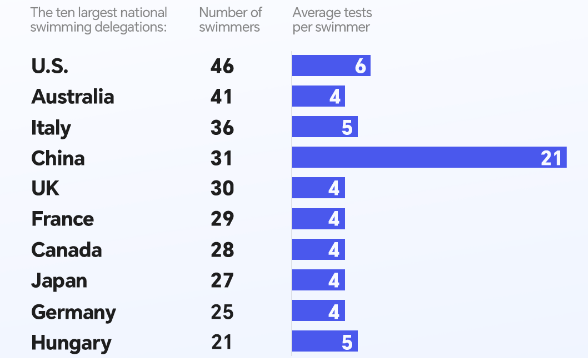
Not only that, some Chinese swimmers were subjected to as many as seven doping tests in a single day at the Olympic village. They were frequently woken up at 5 am to queue for the test, causing severe disruption to their daily rest.
After Chinese swimmer Pan Zhanle broke the world record in the men’s 100m freestyle, Brett Hawke, a former Australian Olympic swimmer and coach, posted on Instagram that “it’s not humanly possible to beat that field” and that the swim was “not real life. Not in that pool, against that field.” This implied that Pan had doped, despite the fact that he had been tested 29 times since last year and passed all the tests. This also highlights a clear example of racism; when European and American athletes break records, it is viewed as a breakthrough for ‘human potential’, yet when Chinese athletes break records, it is labelled as ‘humanly impossible’.
Conclusion
Doping remains a critical issue in the realm of sports, undermining the integrity of competition and the fundamental principles of fair play. The establishment of WADA and WADC have created a framework aimed at combating doping globally, emphasising the responsibility of athletes to remain vigilant against prohibited substances. The fight against doping is not just about enforcing rules; it is also about preserving the spirit of sport, where talent, hard work, and dedication are the true determinants of success.