Although the phrases “contract for service” and “contract of service” sound similar, the words “for” and “of” gives each phrase a different meaning. So, what’s the difference between “contract for service” and “contract of service”?
Contract of Service
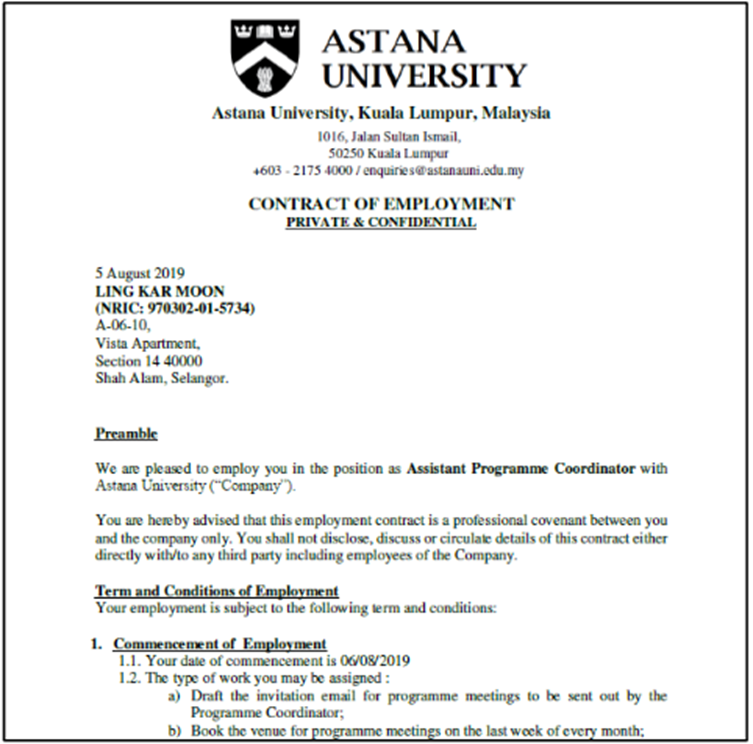
As per s2 of the Employment Act (“EA”), a contract of service is defined as any agreement (whether oral or in writing and whether express or implied) whereby one person agrees to employ another as an employee and that other agrees to serve his employer as an employee. This includes an apprenticeship contract. For context, an apprenticeship contract is as defined in s2 EA whereby it is a written contract entered into by a person with an employer who undertakes to employ the person and train or have him trained systematically for a trade for a specified period which shall not be less than 2 years in the course of which the apprentice is bound to work in the employer’s service.
It should be noted that according to s10 EA, a contract of service for a specific period of time exceeding 1 month or for the performance of a specified piece of work exceeds or may exceed 1 month shall be in writing.
Moreover, a contract of service is also known as a contract of employment. A contract of employment is defined under s2 of the Industrial Relations Act (“IRA”) whereby a contract of employment is defined as any agreement (whether oral or in writing and whether express or implied) whereby one person agrees to employ another as a workman and that other agrees to serve his employer as a workman.
Contract for Service
A contract for service involves a person, business, corporation that provides goods or services under written contract or verbal agreement. However, they do not work regularly for an employer but work as required. They are a contractor who carries out business on own account and their relationship with the person who hired them is that of a client-contractor relation.
It should be noted that independent contractors are not covered under employment and labour laws. They are however, covered under the Contract Act.
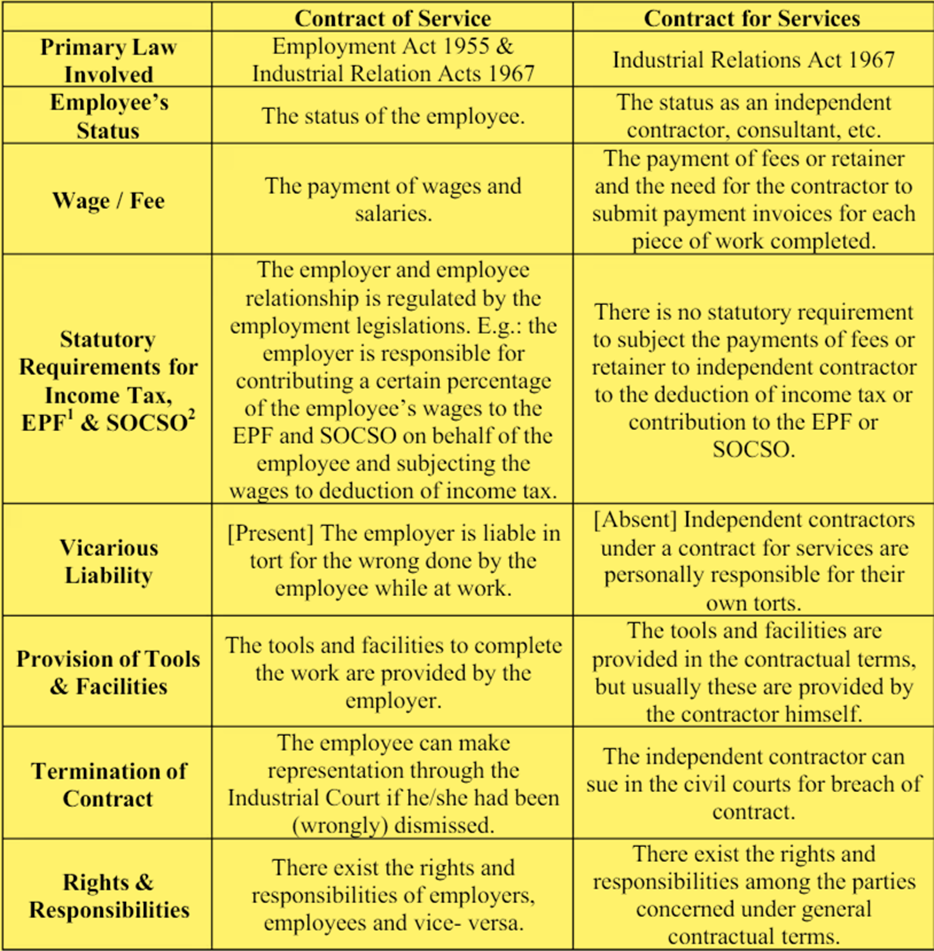
So what are the differences between Contract of Service and Contract for Service?
Tests to Distinguish between Contract of Service and Contract for Service
The distinction between a “contract of service” and a “contract for services” is vital in determining an individual’s legal position. Only an employee/workman under a contract of service will be entitled to invoke the jurisdiction of the Industrial Court in the event where his rights under the statute had been violated by the employer. If not, the claimant can only seek remedy for a breach of contract in a Civil Court (independent contractor under contract for services). This distinction also determines the statutory protection and remedies that can be claimed under the different courts.
It is sometimes difficult to distinguish between a contract of service and a contract for service. As such, the following tests may be applied:
1) Control Test
This test determines how much control is being exercised over the worker by the employer. The more control that is being exercised, it is more likely that the worker is an employee regardless of what the contract says. Essentially, the more control the employer has on the employed means the employed is more likely to be employee. The less control the employer has on the employed means the employed is less likely to be employee.
However, this test was deemed inadequate, thus the fourfold test was introduced in City of Montreal v Montreal Locomotive Works Ltd et al whereby the following four criterion were considered – control; ownership of the tools; chance of profit; and risk of loss.
2) Organisation Test / Integration Test
This test focuses on the relation of the provider of services to the business itself. It considers whether the services provided are an integral part of the business or is adjunct/an accessory to the normal activities of the employer. According to the case of Stevenson Jordan and Harrison, Ltd v Macdonald and Evans, it was held that for a contract of service, a man is employed as a part of the business, and his work is done as an integral part of the business. On the other hand, for a contract for services, although a man’s work is done for the business, is not integrated into it but is only accessory to it.
3) Multiple Control Test
This test considers the totality of circumstances, including comparing certain situations with one another. It was first established in Ready Mixed Concrete (South East) Ltd v MPNI whereby it was held that a contract of service exists if the following 3 elements are present:
(i) There is payment of wages or remuneration;
(ii) There is reasonable control exercised by the employer towards his employee;
(iii) The other terms in the contract must be consistent with it being a contract of service.
This approach places emphasis on the third element.


